Armor Trim Materials — All 10, and What Each Says
The pattern is the shape; the material is the voice. Ten materials color the trim bands, each with its own cost curve and personality. Colors below are schematic approximations - exact in-game shades come from the game itself. Updated November 04, 2026.
| Material | Personality and cost notes |
|---|---|
| Iron | The default look - clean, quiet, matches everything. |
| Copper | Warm and weathered; the vintage pick. |
| Gold | Loud in the best way - the royal classic. |
| Lapis | Deep scholar blue for explore-heavy loadouts. |
| Emerald | Trade-green; loud but friendly. |
| Diamond | Cyan sparkle - the endgame flex. |
| Netherite | Dark and heavy; stealth on bright bases. |
| Redstone | Alarm red; unmissable anywhere. |
| Amethyst | Geode purple; the aesthete pick. |
| Quartz | Near-white line work; the cleanest trim. |
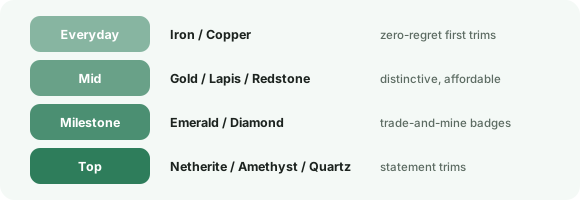
The cost ladder
Materials divide into everyday and precious. Iron and CopperGold, Lapis, RedstoneEmerald and DiamondNetherite, Amethyst, Quartz
A worked example: budgeting a full set
Say you settle on Coast + Gold after an evening on the tester
Half of a material's personality is community history. RedstoneAmethystCopperGoldEmerald
Full sets do not have to wear one material. The classic split keeps one material for the
chestplate and helmet - the pieces people see first - and a quieter partner on leggings and boots:
Gold on top with Iron below, Diamond on top with Quartz below. The rule that keeps mixing from
looking accidental is a shared tone: pair metals with metals (Gold and Iron), near-whites with
near-whites (Quartz and Diamond), or commit to a two-color story deliberately (Redstone helmet as
the marker, Netherite everywhere else). Mixed sets also solve the budget problem: a Diamond-accent
chestplate with Iron-trimmed legs reads intentional while costing a fraction of four Diamond
applications. Preview the mixed set on the tester
Every color on this site is a schematic approximation in a controlled palette, and screens vary:
night lights, brightness settings and GPU color profiles all shift how Copper or Emerald actually
read on your monitor, and the game's own lighting applies another layer - a Gold trim at noon reads
different from the same trim in a ravine. Treat the previews here as relative truth (Gold is louder
than Iron, Quartz is quieter than everything) rather than absolute color matching. When two
materials feel close in the preview - Copper against Iron, Amethyst against Lapis - the in-game
difference will be just as subtle, which is itself useful information: those are the pairs where
personal taste, not visual impact, should decide. The same material flips personality across bases, which is why the testercombinations guideThe lore each material carries
Mixing materials across a set
Colors on screens: the honest caveat
Pairing materials with bases
Frequently asked questions
What materials can armor trims use?
Ten: Iron, Copper, Gold, Lapis, Emerald, Diamond, Netherite, Redstone, Amethyst and Quartz. Each colors the pattern bands; the material is consumed per application.
What is the cheapest trim material?
Iron and Copper - both are common ingots, which makes them the natural first trims. Gold sits one tier up in cost and several tiers up in visibility.
Do trim materials change stats?
No - trim materials are cosmetic inputs. A Redstone-trimmed helmet protects exactly like an untrimmed one; only the pattern bands change.